QUIZ #2
I just got to visit my homestay family again after 10 months, which was terrific. It was a happy reunion, because I could actually understand what was being said and respond in a comprehensible way. It is crazy how fast kids change. I also remember being incredibly intimidated to walk down the street during training, fearing that I'd greet someone improperly, or be harassed for money. Now it seems so natural; it's like returning to your old elementary school as an adult and wondering how you could ever have found it so intimidating with its knee-high desks and water-fountains. Now I'm headed back to site, where I hope to get a lot of villagers to come to an agroforestry introduction by advertising it as cheap fertilizer. We'll see how that goes.
Here's another quiz for those of you who liked the last one: I live in the Southern Highlands of Tanzania. Which of these can be found at my site?
a. dancing chameleons
b. giant crabs that climb coconut trees and steal the coconuts
c. coconut trees
d. big hairy spiders
e. cobras
f. trees with huge seed-pods shaped just like sausages
g. trees with huge seed-pods shaped just like eggs
h. trees with huge seed-pods shaped like Belgian waffles with whipped cream
i. donkeys
j. lions
Here are the correct answers: a,d,e*,f,i
There are no lions, coconut trees, or giant crabs (I'm about a 12 hour bus-ride from the ocean, but these do exist on Zanzibar), and there is only one type of breakfast-food-like seed-pod that grows on trees.
There are chameleons that change color and they walk kind of like the moves to “Walk Like an Egyptian,” which I've been told is to fool predators into thinking they are sickly (because anyone who would do that dance in public must be deranged). Sometimes it's hard not to run them over on your bike. There are lots of big hairy spiders that like to watch over me as I sleep, so I can vouch for their existence. To my neighbors, anything that squirms is deemed a “cobra,” hence dangerous and thus must be exterminated. But I could swear that most of the time they are garter snakes or even earthworms. If I look skeptical at my neighbors' classification of the creatures, they will clarify: “a baby cobra.” Sausage trees ARE as gross-looking as they sound, but I've heard that you can carve the pods into chairs and have a comfy sit-down. I've never tried it, nor seen any that are big enough for that. Oh, and donkeys are kind of boring, but useful and present in small numbers. Thanks for playing! Hope you did well.
Friday, June 08, 2007


Saturday, June 02, 2007
These days my main project is guacamole. Most people here have never had it, but I am hoping that after 3 years the village will abound with the two essential ingredients, avocados and lemons, which grow on trees and we are planting those trees.
I also want to start a dictionary of Swanglish words. Some of the words that everyone uses in English (even though you native-English-speakers may never have heard of them) are:
1. Frumpin
2. Piss Kop
3. Watakani
4. Pipe wrange
5. Godown
You might be able to decipher a couple of them. They mean (respectively) frying pan, Peace Corps, watering can, pipe wrench, and the "go down" is, inexplicably, a granary. There are many words that you can just add extra I's to if you want to Swahilify them. A good example is wikiendi (weekend).
This morning before I left my village I had the new experience of going to a grave-building party. My counterpart's mother died a long time ago, but he explained that they still needed to build a tombstone so that nobody will ever build a house on top of her. I arrived at 7:30 in the morning and was greeted by some already-tipsy old ladies who didn't understand when I declined their offers of local brew by saying "it's too early for drinking." Unfortunately I had to leave before any of the grave-building fun could begin. Maybe next time.
Thursday, May 24, 2007
The 200 Shilling Question
I am definitely living in rural Tanzania. See if you can guess which one of the following things happened yesterday at the village meeting:
a. The meeting had to be postponed because of a pack of baboons ravaging a nearby maize field.
b. The meeting ended with all the village leaders crouched in a field eating bugs.
c. The meeting was interrupted because we had to go to a burning to drive out the witchcraft that had taken hold of one of the village elders.
d. People arrived on time.
If you guessed a, you are wrong, but good guess because I have heard (although haven't actually seen) that baboons are a real threat to maize fields.
If you guessed c, you are wrong, but good guess, because I have been to a meeting where everyone was even later than usual because the pastor was performing an exorcism of bad magic which involved burning, but luckily, as I found out, not of people.
If you guessed d, haha. Not in a million years.
If you guessed b, you have just won 200 Tanzanian shillings! (Please visit Tanzania to collect your prize before May 26, 2007).
If you want to try again, here's another test:
Which of these tales is true?
a. While barreling down the hill on my bike I was flagged over by a guy going uphill. He apparently thought the best tactic for convincing me to marry him was telling me that I had already agreed. "So, remember when we decided to get married? Yeah, so when's that going to happen?" I have seen him twice before in my life, and have had the formulaic Kihehe (local language) conversation with him, which he must have read too much into.
b. My four-year-old neighbor told me I was going to heaven due to my sweet-potato-planting skills.
c. I carried water on my head and nobody gawked.
d. Frozen precipitation fell from the sky.
e. I turned into a young (and less felonious) Martha Stewart, making bean "tacos." This entailed growing beans, tomatoes, carrots, and corn, harvesting them, and then drying the corn and getting it ground into a flour to be used for tortillas*. They were... edible.
*I am using a loose definition of tortillas, as the flour didn't stick together so came out in little thick chunks. Eating it was much less graceful than you might imagine.
Answer: All of the above except c. No chance of even breathing without being gawked at.
Thanks for playing.
Tuesday, May 08, 2007
The dry and "cold" season has begun. I am hoping that contour-ridging on my farm has managed to save enough moisture to push through my remaining crops: a little bit of wheat, broccoli and sunflowers.
My main activities these days have been AIDS-related. I just finished a seminar for a group of about 15 out-of-school youth who were interested in becoming AIDS educators. I looked forward to teaching them every day because they were pretty enthusiastic, and so grateful for my time. Tomorrow we are having a pretty big party for those who passed the test to become AIDS educators. They organized the whole thing and invited all the village leaders from surrounding areas. I only have to provide them with certificates. There is rice involved, and you know that if there is rice involved in any kind of party, it must be pretty special. I'd say it's pretty much the same way a birthday cake makes a birthday party.
There was also a big village-wide meeting that came at the request of another NGO which is apparently giving money for AIDS education. The point of the meeting was to determine why villagers thought AIDS was so prevalent in the area. They divided into groups and then were supposed to say what caused AIDS. Topping the list was drunkenness, followed by "careless sexual practices," which I took to mean without a condom, but there was absolutely no mention of condoms outright. It was a very interesting learning experience for me. I gave a short speech about life skills, AIDS testing, and stigma about AIDS, but was careful not to alienate myself by bringing up the topic of condoms. On Thursday, all interested villagers are invited to a lesson about AIDS, which will mainly be determining what they want and need to know about the disease. But I will be very surprised if anyone shows up. Farm work has died down, but there have been so many deaths in the village recently (averaging 2 per week for the last month) that it has been hard to get any work done.
Friday, March 23, 2007
The rainy season is nearing its end, and it’s not looking pretty for the people in our region. Last year the rainy season was too short, leading to bad yields, and this year the rains were on time, but much heavier than expected, and the flat-farming of maize and beans practiced on our rolling hills suffered, and has led to predictions of famine. The yellow bean leaves and corn that tassled at the height of my knees are a hauntingly common sight. You can see that the topsoil has been washed away and there is devastating erosion in some places. The saddest thing though, is that a lot of it could have been prevented by a little bit of terracing, and digging ditches on the contours. I have my work for this year cut out for me.
Yesterday my Country Director and the Permaculture Specialist came to my site on their rounds of visiting all of the volunteers. They were very happy with my farm, which I never really considered Peace Corps work because it’s just something I do in my free time. They recognized it as just the first attempt a green farmer (green because I’m a novice, green because it’s organic, and maybe green due to weeds), and definitely found a lot of things I could work on to make it more productive, but said that it was a great example, especially due to the central location (right outside the school on the main road where everyone can see it). Who knew that it’s considered work just because I can’t go 5 minutes without talking to the people that pass by the farm and exchange advice? In the past 4 months I have progressed from being shocked every time green things come out of the ground because I put seeds in it, to having to plan my diet around what's ready. The list of things growing now includes corn, beans, cabbage, pumpkins, peanuts, garlic, onions, Chinese cabbage, broccoli, carrots, bambarra nuts (yeah, I didn’t know what they were either! They grow like peanuts), lettuce, tomatoes, potatoes, cilantro, basil, nasturtiums, mango trees, pigeon peas, and soy beans, and the sunflower and wheat have been planted but have yet to sprout.
I did get the kitten I had mentioned, but so far her contribution to my living situation has not included killing any rats. Her pastimes do include climbing me, eating enough food to make her stomach almost drag on the floor, and stealing sponges.
Small projects I am working on are a brief lesson for all the Mamas in the village about respiratory tract infections, an AIDs seminar for the teachers, a primary school environmental club, and a tree nursery group.
I recently had a good conversation with our new head teacher, as I had planned to discuss the problem of elementary school students who live far away. Just like many American students (especially Alaskans in winter), these kids get up before the sun rises, but then they walk an hour or an hour and a half to school (or run some of the way), endure beatings if they’re late, spend the entire day at school (even the 2 hour break which should be for lunch), and walk all the way home, arriving after dark for their 1 meal of the day. It would be incredibly hard to orchestrate a school-lunch program that would be sustainable, but we are going to try and get parents to start packing lunches for their kids, and the teachers will put the lunches in a safe place.
Friday, February 02, 2007
Projects
On Wednesday I did my first project requiring grant money. It required bringing 350 fruit tree seedlings to the village to be sold (we bought for the US equivalent of 50 cents each, and sold for 5 cents each so that everyone could afford them). I went in the morning with my village's Agricultural Extension Officer to pick up the trees, and upon returning to the village, found that a thief had been caught. All I could think was "Oh no, I left 200,000 shillings (about $150) in my house for the project because I didn't want to travel with it, and now it's been stolen." But it turned out he had just stolen some chickens and a small radio. The thief was not from my village; he was from a village about 5k away. They were taking him to the village office to deal with him (yell at, beat, psychologically harass, and negotiate a punishment). Incidentally the village office was where the tree project, which consisted of a short seminar on seedling outplanting and care as well as the selling of the trees, was to take place. This was both good and bad. It meant that there were a lot of people at the office, but they were mostly distracted, and had not really come with the intent of buying trees. They all decided to take a small break from the thief and sit and listen to the Agricultural Extension Officer give his spiel right outside the office, while the thief was locked up inside with the windows open. People were showing up to look in the window at him while the lesson was going on. All in all, the project went well, and despite everyone telling me how few trees we had bought, it turned out to be the exactly perfect number. Now we will see how many of the seedlings survive!
My other main project right now is a seminar to teach the leaders of the AIDS Committee in my village about AIDS and how to teach about it. It is going pretty well, though a couple of the people have to walk from about an hour away to get to my house where we are holding the seminar, and sometimes communication is difficult.
I am going to get a cat next week which should help because my house is overrun (that is not an understatement) with rats. They don't even mind when I'm around anymore, they just look at me and continue chewing whatever random thing they might get their teeth on (toothbrushes, toothpaste containers, my phone, potatoes, plastic bottles, iron supplements, etc.).
It's good to be busy, but it means I have had very little time to work on my farm, so it is looking very neglected!
Thursday, January 18, 2007
A PEPFAR Grant and Training
My first grant went through! It's only for about $180, but it went through just fine, so next weekend we are going to sell fruit tree seedlings in the village (orange, lemon, passion fruit, custard apple, guava and a few more). We are buying them for the equivalent of 50 cents and selling them to villagers who attend a seminar for 5 cents each. We're doing a seminar on how to care for seedlings properly, so that hopefully they will all survive. The grant is PEPFAR (President’s Emergency Plan for AIDS Relief), so I had to make the project relate to AIDS as much as possible. There's a group that takes care of orphans by providing them with a plot of land to farm and seeds when they graduate from the 7th grade, and they get to order seedlings first. Then the seminar will include a little spiel about how fruit relates to proper nutrition, and how proper nutrition is so important for people with diseases like AIDS. I'm excited.
We are in Iringa for AIDS education training, so today we went to an elementary school and taught two lessons. It was surprising to me how much the kids already know. I think what is really needed are more life skills lessons, where they learn and practice skills like saying "no" assertively, having positive role models and developing goals. I hadn't really thought much about how important those things are until recently. I can see how much easier it would be to do the right thing in a tough situation if you'd done a skit about it in class, or if you had some lines prepared to say to someone who was pressuring you. It is a lot like the DARE program from elementary school (Drug Abuse Resistance Education). My counterpart and I are thinking about how we are going to teach when we get back to the village.
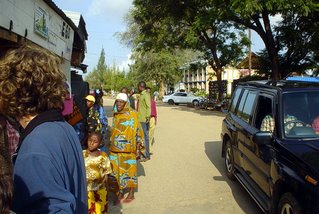

It is nice to be in town and get things like cheese and chocolate, but it will be nice to get back to my little farm!
My first grant went through! It's only for about $180, but it went through just fine, so next weekend we are going to sell fruit tree seedlings in the village (orange, lemon, passion fruit, custard apple, guava and a few more). We are buying them for the equivalent of 50 cents and selling them to villagers who attend a seminar for 5 cents each. We're doing a seminar on how to care for seedlings properly, so that hopefully they will all survive. The grant is PEPFAR (President’s Emergency Plan for AIDS Relief), so I had to make the project relate to AIDS as much as possible. There's a group that takes care of orphans by providing them with a plot of land to farm and seeds when they graduate from the 7th grade, and they get to order seedlings first. Then the seminar will include a little spiel about how fruit relates to proper nutrition, and how proper nutrition is so important for people with diseases like AIDS. I'm excited.
We are in Iringa for AIDS education training, so today we went to an elementary school and taught two lessons. It was surprising to me how much the kids already know. I think what is really needed are more life skills lessons, where they learn and practice skills like saying "no" assertively, having positive role models and developing goals. I hadn't really thought much about how important those things are until recently. I can see how much easier it would be to do the right thing in a tough situation if you'd done a skit about it in class, or if you had some lines prepared to say to someone who was pressuring you. It is a lot like the DARE program from elementary school (Drug Abuse Resistance Education). My counterpart and I are thinking about how we are going to teach when we get back to the village.


It is nice to be in town and get things like cheese and chocolate, but it will be nice to get back to my little farm!
Monday, January 15, 2007
HAPPY NEW YEAR
The past month has been so busy, with our in-service training, a visit from my friend Rafael on his winter vacation from Nova Scotia, and now a President's Emergency Plan for AIDS Relief seminar. We are now allowed to start projects, so I am working on trying to get fruit tree seedlings to plant before we get too far into the rainy season.
Rafael was a terrific guest; we didn't actually do any of the typical touristy things. Instead we spent the majority of the time in my village, meeting villagers (a few of whom spoke English with him, a few of whom rattled on in Swahili or even Kihehe heedless of his confusion). He even tagged along to another subvillage where I was doing evaluations of permaculture seminars, and got a tour of some farmers' fields. My friend, who owns a little shop where she sells maandazi (fried dough) and milk, was very impressed when he quickly learned to fry the maandazi. It was nice because men in the village don't cook if they are married, so to see the mzungu frying maandazi was quite a wake-up call. I explained how men in Canada and the US often will cook, clean and even do laundry for themselves, even when they're married! They thought that was hilarious. We have a long way to go.
It was also really nice to have a friend helping out on the farm. I have only a half or a third of an acre, but it's taking me quite a while to get the whole thing prepped and planted. I have about 1/3 of it done so far, but will get back to work when I return next Saturday. It is nice because people come by and ask me why I'm farming the way I do. This year the rains are incredibly heavy, and many many people have lost their bean crops and have had parts of their fields washed away. I've had a number of people say that if they'd known the rains would be so strong, they would have done their farms like me (that is with contour ridging and ditches). I am currently on a campaign to get everyone to dig ditches, which I think is the most important thing I could possibly get them to change at this point.

Me in my contoured and ditched garden.
We spent Christmas with about 25 other wazungu at my friend's village in Njombe. It was a lot of fun, and if the idea of a fat man who lives in the North Pole and spies on you all year to judge your behavior and then comes around to put presents or coal in your socks isn't weird enough, we decided to have a Christmas pinata. We hung it out on a tree and a bunch of villagers gathered around and watched us beat the thing. Some even joined in. It was a blast. We also had a deep-fried turkey.
I hope everyone had as lovely and interesting holidays as we did here!
Tuesday, December 19, 2006
Peace and Season's Greetings to All
I can't believe it's Christmastime! That seems so bizarre right now. I think we are getting a turkey to cook on the charcoal stove.
We have been having an in-service training this week. I returned to my village with a friend who lives in Njombe, because we had a free day on Sunday. It was really cool getting to show him my village. Plus he is one of the most hilarious people I've met in my life. I got a chance to work on my farm a tiny bit, but it was the Sabbath and my farm is right on the road, so I got lectured by several people passing by that I shouldn't be working. I really wanted to get a little bit of a start though, and won't be back in my village for a long time, so I felt it was necessary.
My corn is healthy, my garbanzos and beans are growing, the Chinese cabbage is up but being ravaged by something, half of my peas were eaten, half survived, and the tomatoes, carrots, lettuce, onions, basil, mint, beets and eggplant have yet to come up. We'll see. I plan to plant pumpkin seeds, potatoes, peas and beans on my farm.
The major thing that came out of training was a rough plan to buy seedlings and plant them in January. I'm still working out the details with my village executive officer. The training was fun, and it was good to work on planning a project.
Wednesday, December 06, 2006
Permaculture, Rain (Hooray!!) and the Answer to the Rooster Question
I had 3 days packed full of permaculture fun. The first day, we went to one of the subvillages and 80 people showed up for the meeting. It went pretty well. Then in another subvillage we showed up and nobody was there, so we moved the meeting to the kilabu, which is a cluster of buildings where the local brew is sold. People showed up expecting to while away the afternoon and maybe get a bit tipsy, but we sat them down and started the class. There were 15 people, and I have to say it was probably the best of all our sessions so far. The next day we had invited tons of people from all kinds of clubs, but only 6 showed up. But they were a jolly group of elders, very excited about the seminar. My counterpart had to translate everything into Kihehe though.
Here's the good news: it's the rainy season!!! Such a relief. It has been raining for about a week now. It rains for a couple of hours each day usually. And when it rains it pours. The first day it rained I stood in my enclosed courtyard under the roof and took a shower!
The downside to this is that I felt a panic to get my garden planted. I set about permaculturing the entire thing, which involves double-digging all the beds and digging swales and ditches, and the clincher is that I don't have a shovel, just a hoe. But I think it is important that I used only a hoe, because that is the only implement at most of the villagers' disposal. I didn't realize how big my garden was until I began this formidable task. It was probably one of the more difficult physical accomplishments I have undertaken in my life. I didn't have any compost, but I will get some. I have planted carrots, lettuce, eggplant, beets, kale, peas, a few potatoes, garbanzo, corn, beans, basil, mint, and tomatoes. We'll see what works. Some of the seeds are a little iffy.
Oh yeah, and finally in answer to the question posed in my first blog entry, roosters say "Kokolikoo".
Subscribe to:
Posts (Atom)